Blog
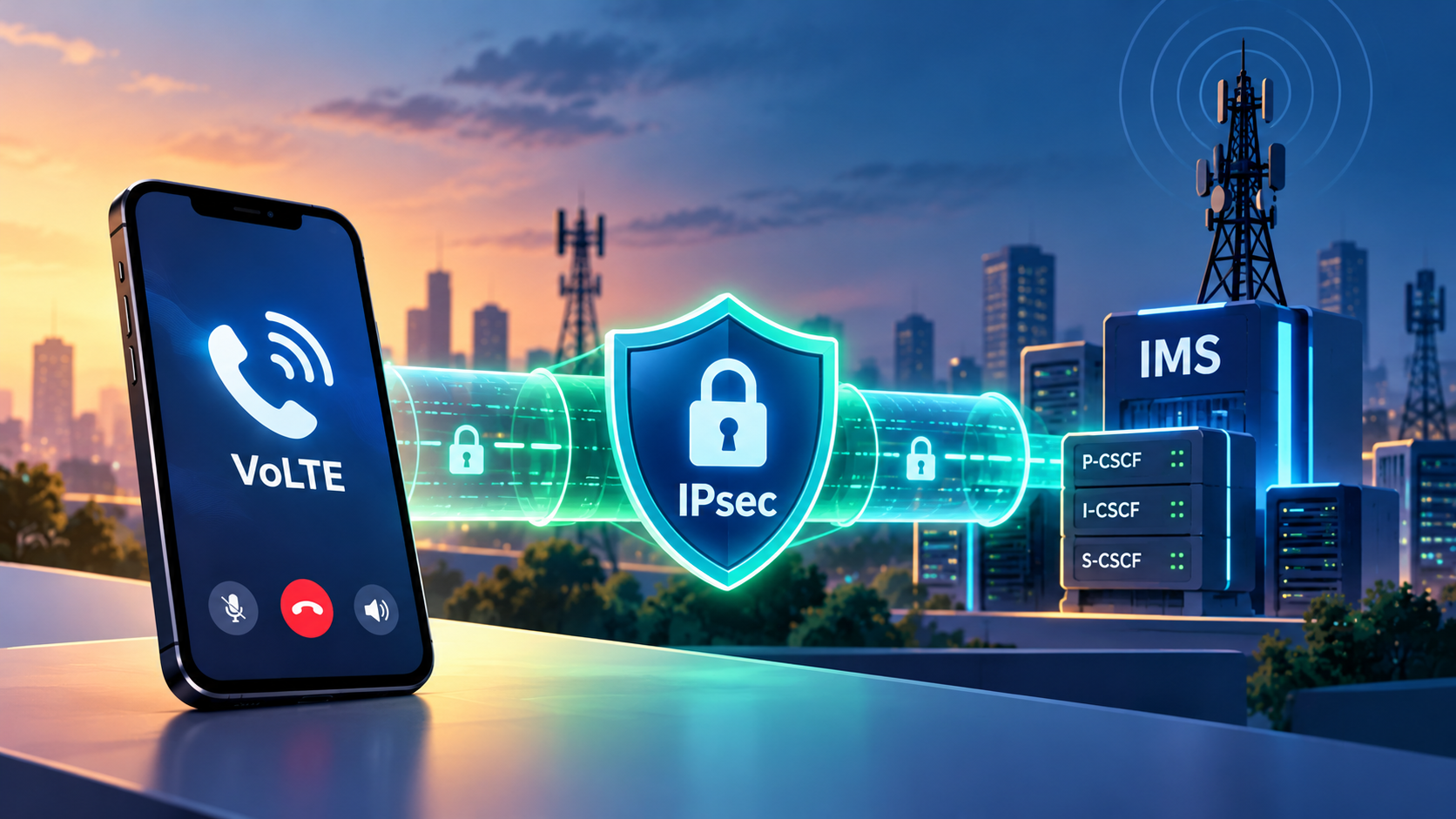

IPsec is a suite of network-layer security protocols that can protect IP communications through encryption, integrity checks and peer authentication, depending on the configuration. In Voice over LTE (VoLTE), IPsec may help protect selected signaling paths associated with the IP Multimedia Subsystem (IMS). However, IPsec is not a complete security strategy on its own. Operators need to understand where protection applies, what it does not cover, and how it works alongside access controls, filtering, hardening and monitoring.
IPsec security for IMS refers to using IPsec mechanisms where supported by the network architecture to protect relevant IP traffic between defined endpoints. Depending on the deployment, this may help protect signaling traffic against interception or tampering while helping authenticate peers. The exact role of IPsec depends on the interfaces, endpoints and security design in use.
IMS signaling protection covers more than encryption. It also includes ensuring that only approved systems communicate, that messages follow expected policies, and that unusual traffic can be detected and investigated. IPsec should therefore be considered one layer in a broader IMS security architecture.
VoLTE relies on IMS components and signaling exchanges to establish and manage voice sessions. Where IPsec is appropriate and correctly configured, it can help protect supported communication paths and reduce exposure to certain network-level threats. This can contribute to VoLTE network protection and wider telecom network security.
Still, the presence of IPsec does not prove that the entire VoLTE environment is secure. Traffic may traverse segments outside the protected association, endpoints may be misconfigured or compromised, and authorized peers can still generate unwanted or malformed messages. Operators should validate the actual coverage rather than assuming that enabling IPsec closes every gap.
Confidentiality: encryption can help prevent unauthorized parties from reading covered traffic.
Integrity: integrity protection can help detect unauthorized modification of protected packets.
Peer authentication: configured mechanisms can help verify the identity of a communicating endpoint.
Network-layer protection: IPsec can protect supported IP traffic without requiring every application to implement its own encryption.
These protections depend on the selected IPsec mode and algorithms, correct endpoint configuration, secure key management and the traffic actually covered by the security association. Operators should verify implementation details against applicable standards and vendor guidance.
IPsec protects traffic that matches the configured policies and security associations. If traffic takes another route, crosses an unprotected segment or uses an interface outside the defined scope, that traffic may not receive the same protection. Map signaling flows and verify coverage at each relevant boundary.
An authenticated peer may still send traffic that is unnecessary, misconfigured or harmful. IMS access security should restrict which systems can connect and what they are permitted to do. Combine IPsec with least-privilege network access controls, peer validation and clear authorization rules.
IPsec can protect packets in transit, but it does not automatically determine whether a SIP message is appropriate for the service, conforms to operator policy or represents legitimate activity. IMS traffic filtering and protocol-aware validation are still needed at suitable network boundaries.
Incorrect peer definitions, weak or outdated cryptographic settings, expired credentials, poor key handling or inconsistent configurations can undermine protection or cause service issues. Apply approved configuration baselines, protect keys, monitor tunnel status and review changes through controlled procedures.
IPsec does not make a compromised endpoint trustworthy, nor does it by itself prevent every denial-of-service scenario. Resource exhaustion, routing problems and application-level weaknesses may remain possible. Use endpoint hardening, capacity safeguards, monitoring and incident-response plans as complementary measures.
A layered approach should include the following controls:
During a scoped IMS security assessment, operators should confirm:
Strong VoLTE security best practices combine appropriate IPsec deployment with secure configurations, IMS access security, signaling validation and continuous monitoring. Treat IPsec as a defined control with measurable coverage, not as a substitute for the rest of the security architecture. Keep network diagrams and policies current, review external connections, and reassess controls after changes to services, vendors or interfaces.
IPsec security for IMS can provide valuable protection for supported IP communication paths, but its effectiveness depends on correct configuration and clearly understood coverage. Operators should account for IPsec security limitations and combine IPsec in VoLTE with IMS signaling protection, traffic filtering, access control, segmentation, hardening and monitoring. This layered approach helps strengthen VoLTE infrastructure security while reducing the risk of relying too heavily on a single control.