Blog

4G/LTE networks depend heavily on signaling to authenticate subscribers, manage mobility, exchange subscriber information, apply policies, and support charging. Much of this communication is handled through the Diameter protocol.
As LTE networks connect with roaming partners, IPX providers, interconnect networks, and other external environments, protecting Diameter signaling becomes increasingly important. A compromise or misuse of signaling traffic can potentially affect subscriber information, authentication processes, routing, and network availability.
A Diameter firewall provides a dedicated security layer for controlling this traffic. Unlike a conventional network firewall that primarily works at the IP and transport layers, a Diameter firewall can understand Diameter signaling and apply policies based on Diameter-specific information.
This article explains how Diameter firewall security protects LTE signaling, how Diameter security monitoring complements firewall controls, and the key Diameter security best practices telecom operators should consider.
LTE signaling enables critical communication between core network elements.
For example, the S6a interface allows the MME to communicate with the HSS for subscriber authentication and mobility-related functions. Other Diameter interfaces support policy control, charging, and roaming-related operations.
These signaling paths can carry information associated with:
The security of these signaling paths therefore directly contributes to the security and reliability of the LTE network.
The risk becomes greater when Diameter signaling crosses organizational boundaries, such as during roaming or interconnect communication.
Potential threats include:
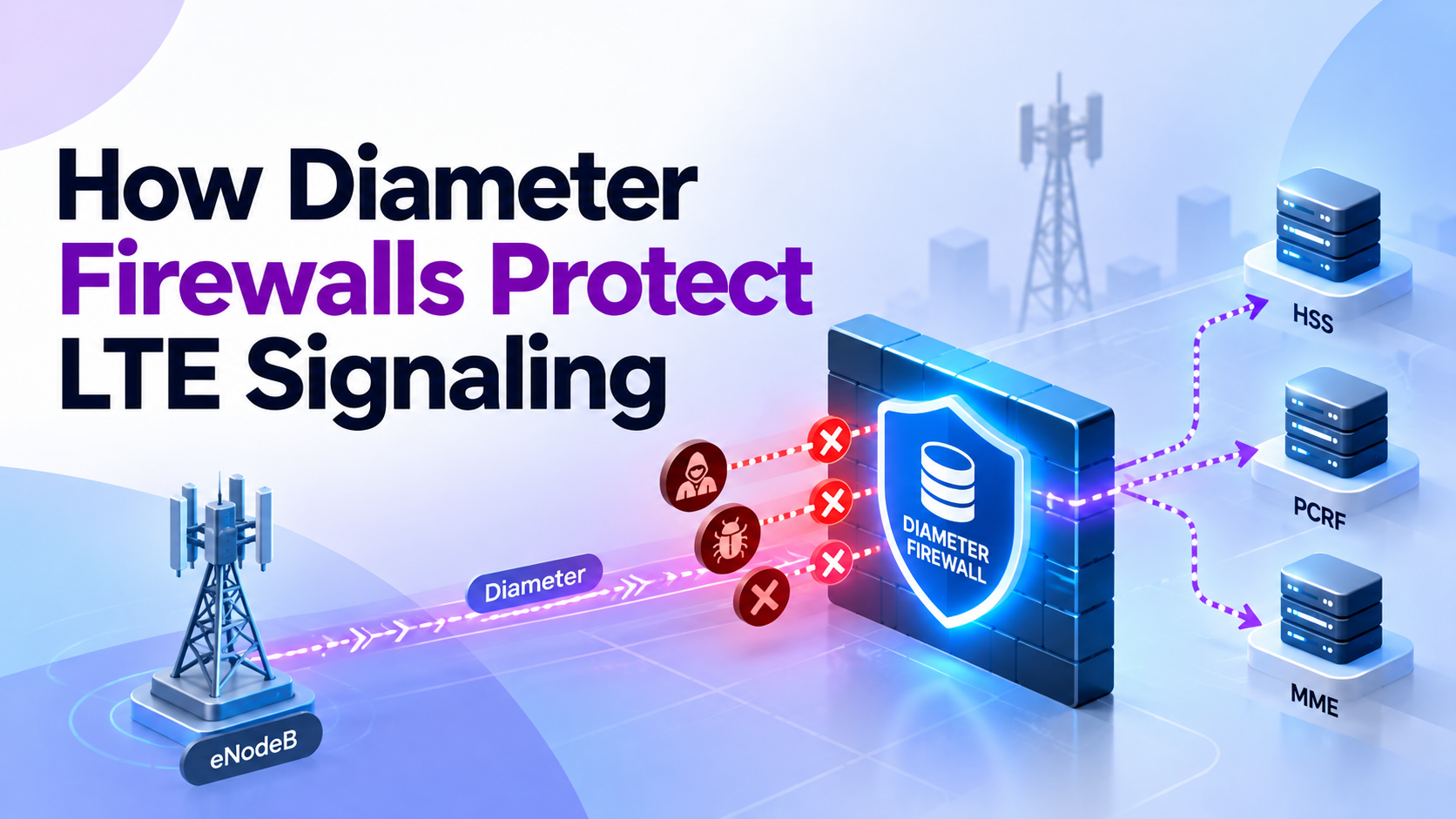
A Diameter firewall acts as a security enforcement point for Diameter traffic.
A simplified architecture looks like this:
External / Roaming Network
↓
Diameter Firewall
↓
Operator Diameter Infrastructure
↓
LTE Core Network
The firewall evaluates signaling traffic before it reaches protected network elements.
Depending on its capabilities and configuration, it can inspect:
Based on configured policies, traffic can then be:
Allowed → Rejected → Filtered → Logged → Monitored
This provides operators with greater control over which signaling traffic is permitted to enter or leave protected network environments.
One of the first security controls is determining who is allowed to communicate with the network.
A Diameter firewall can enforce policies around authorized peers and connections.
For example, if an operator has approved Diameter connections with specific roaming partners, traffic from an unknown source should not automatically receive the same level of trust.
Peer controls can help prevent:
Maintaining an accurate peer inventory is therefore an important part of Diameter security best practices.
A Diameter firewall can inspect signaling messages and determine whether they comply with defined security policies.
Filtering policies can consider:
For example, an operator may restrict certain Diameter commands from being received from an external peer when those commands are not required for the approved interconnect relationship.
This reduces unnecessary signaling exposure.
Diameter messages contain Attribute-Value Pairs (AVPs), which carry information used by Diameter applications.
Depending on the firewall's capabilities, operators can apply policies to specific AVPs or combinations of AVPs.
This is important because an apparently legitimate Diameter connection could still generate suspicious or unauthorized requests.
AVP-aware controls can help identify and restrict:
This provides a deeper layer of Diameter firewall security than basic IP-based filtering.
Diameter routing determines where signaling messages are delivered.
Incorrect or overly permissive routing can expose internal network elements or allow signaling to reach destinations that should not receive it.
A Diameter firewall can help enforce routing policies around:
This is particularly important for roaming and interconnect environments where signaling may pass through intermediary Diameter agents.
Diameter signaling can be targeted with excessive or abnormal requests.
For example, a compromised or malicious source could generate unusually high volumes of signaling traffic.
A Diameter firewall can support controls such as:
These controls can help reduce the impact of signaling floods and certain denial-of-service scenarios.
Firewall controls should, however, be carefully tuned to avoid blocking legitimate signaling during normal traffic peaks.
Filtering determines what traffic should be allowed or blocked. Diameter security monitoring provides visibility into what is actually happening across the signaling environment.
Monitoring can track:
This visibility can help security teams identify suspicious behavior that may not immediately trigger a blocking rule.
For example, an authorized peer generating an unusual volume of requests may warrant investigation even if the traffic technically complies with basic firewall rules.
A useful security model is:
Firewall → Prevent
Monitoring → Detect
Investigation → Understand
Testing → Validate
Remediation → Improve
This layered approach is more effective than relying on firewall filtering alone.
Diameter firewalls can be particularly valuable around interfaces that support critical LTE functions.
S6a
The S6a interface supports communication between the MME and HSS for authentication, authorization, and mobility-related operations.
Gx
Gx supports policy and charging control between relevant LTE network functions.
Gy
Gy supports online charging communication.
S9
S9 supports policy control in roaming scenarios.
The exact security requirements vary by interface and deployment, but operators should ensure that only necessary traffic and authorized relationships are permitted.
Effective Diameter firewall security should be supported by a broader set of operational practices.
1. Maintain an Accurate Peer Inventory
Know every authorized Diameter peer and its intended purpose.
2. Apply Least-Privilege Access
Give each peer only the applications, commands, and destinations it actually needs.
3. Use Application-Aware Filtering
Filtering should consider Diameter applications rather than relying only on IP addresses and ports.
4. Validate Messages and AVPs
Inspect relevant messages and AVPs for unexpected, malformed, or unauthorized information.
5. Protect External Connections
Apply appropriate controls to roaming, IPX, and interconnect-facing signaling.
6. Monitor Signaling Continuously
Implement Diameter security monitoring to identify unusual traffic patterns, peer activity, and firewall events.
7. Review Rules Regularly
Remove outdated peers, routes, applications, and firewall rules.
8. Conduct Security Testing
Regular Diameter security testing can validate whether firewall controls actually prevent the scenarios they are designed to address.
A firewall configuration may appear secure on paper but still contain gaps.
Testing can evaluate whether:
Testing should be conducted in a controlled environment or against approved test subscribers and systems to avoid affecting live users.
For telecom operators, effective protection can be viewed as five connected layers:
Together, these controls create a stronger defense around LTE signaling.