
Blog
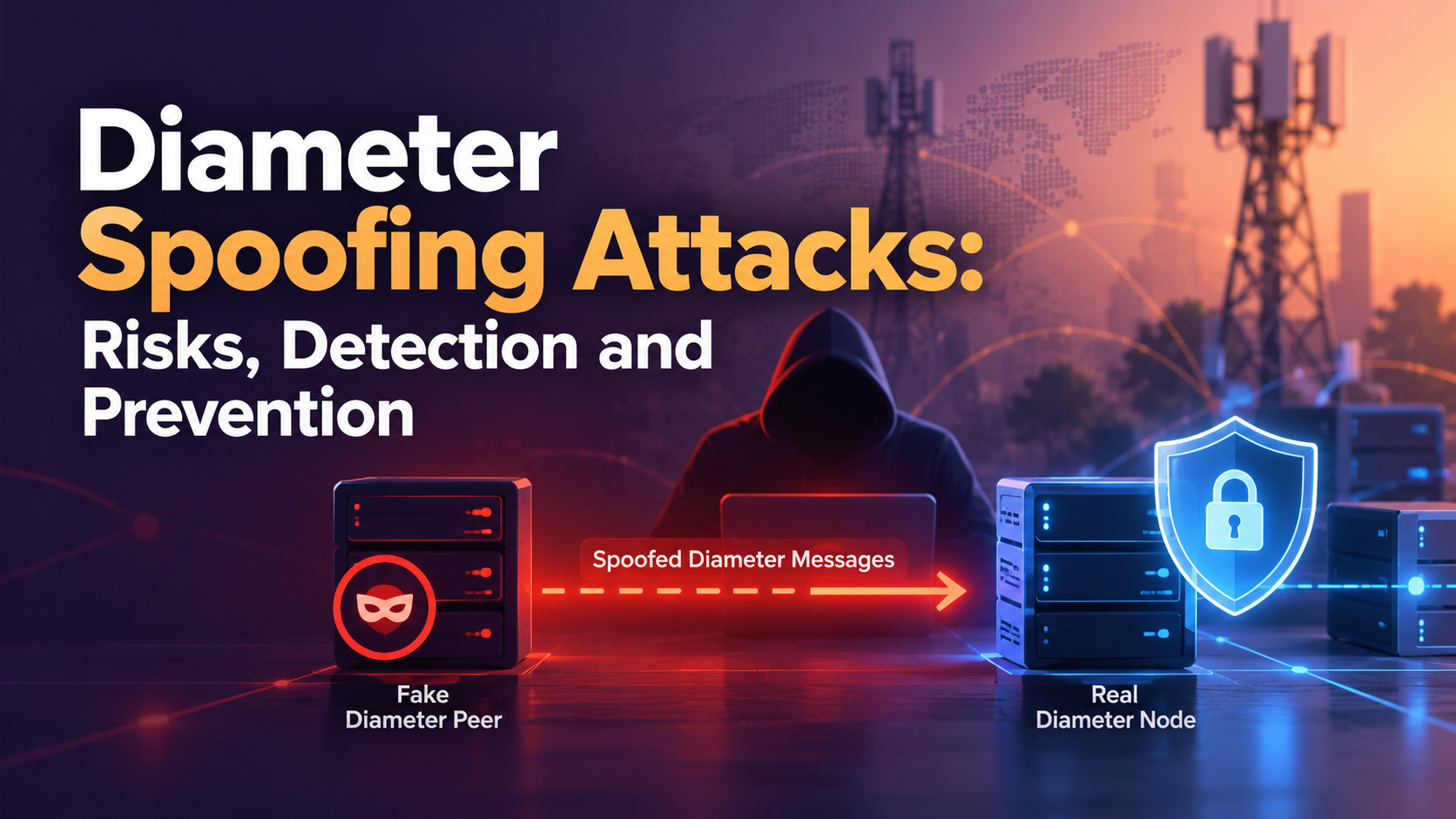

Diameter is a core signaling protocol used across 4G/LTE networks for authentication, authorization, mobility management, subscriber services, and roaming. Because Diameter relies on relationships between trusted network elements, protecting the identity and authorization of those peers is an important part of telecom security.
This is where Diameter spoofing becomes a significant concern.
A spoofing attack attempts to make signaling or a connection appear to originate from a legitimate or trusted Diameter peer. If successful, an unauthorized system may gain an opportunity to send signaling requests that should only be generated by an approved network element.
GSMA maintains dedicated Diameter Interconnect Security guidance that addresses potential Diameter-based attacks and countermeasures for LTE and 5G interconnection environments.
A Diameter spoofing attack is an attempt to impersonate, imitate, or falsely represent an authorized Diameter peer or signaling source.
In a properly secured environment, Diameter nodes should establish communications only with authorized peers. The network should also verify that a peer is permitted to perform the role and applications it claims to support.
RFC 6733 makes an important distinction between authentication and authorization: a Diameter peer may be authenticated but still not be authorized to act in a particular Diameter role.
This distinction is central to preventing spoofing.
A simplified example is:
Legitimate peer → Authentication → Authorization → Diameter signaling
versus:
Unauthorized system → Attempts to appear trusted → Sends signaling → Security control should reject it
The exact attack path depends on the network architecture and security controls in place.
The potential impact of spoofing depends on what the unauthorized source can access and which Diameter applications it can use.
Possible risks include:
These risks are not automatically present whenever spoofing is attempted. The actual impact depends on authentication, authorization, filtering, network segmentation, and application-level controls.
At a high level, spoofing attempts to exploit weaknesses in how a Diameter environment establishes and verifies trust.
Several areas may become relevant.
Diameter peers need to authenticate each other.
If authentication is weak, incorrectly configured, or inconsistently enforced, an unauthorized system may have a greater opportunity to establish a connection.
RFC 6733 specifies support for TLS/TCP and DTLS/SCTP and states that Diameter must not be used without TLS, DTLS, or IPsec protection.
Authentication alone does not establish complete trust.
An authenticated system still needs to be authorized to perform its claimed Diameter role.
For example, an operator may trust a certificate or identity but still need to determine:
RFC 6733 explicitly requires Diameter peers to verify authorization before establishing peer relationships.
Roaming and interconnect relationships introduce additional trust boundaries.
A Diameter environment may involve:
Home Network → IPX / Interconnect → Visited Network
Each relationship should have clearly defined security policies.
GSMA's LTE roaming guidance includes anti-spoofing measures for Diameter Edge Agents, including peer-specific whitelisting and checks involving origin realms.
This demonstrates why spoofing prevention needs to extend beyond internal Diameter nodes.
Diameter spoofing and Diameter message manipulation are related but different security concerns.
Diameter spoofing
The attacker attempts to appear to be an authorized source.
Diameter message manipulation
The attacker attempts to influence the contents or parameters of Diameter signaling.
They can potentially occur together.
For example, an unauthorized source that successfully impersonates a trusted peer could then attempt to send manipulated Diameter messages.
This is why preventing spoofing should involve both peer authentication and message-level validation.
LTE Diameter vulnerabilities can arise at multiple layers of the signaling environment.
Potential areas include:
A Diameter vulnerability assessment should therefore examine the complete trust model rather than only checking whether Diameter connections are encrypted.
GSMA's Diameter vulnerability research has emphasized that an integrated security approach is needed to address Diameter threats and that regular analysis of mobile network security is important.
Spoofing can potentially support several broader Diameter attack vectors.
Unauthorized Signaling
An attacker attempts to send requests normally restricted to approved peers.
Subscriber Information Access
An unauthorized source may attempt to request subscriber-related information if application and access controls are insufficient.
Location-Related Abuse
Spoofed signaling could potentially be used to request mobility-related information where controls allow it.
Profile Misuse
Unauthorized requests may attempt to interact with subscriber-related procedures.
Diameter Message Manipulation
Once an unauthorized source gains a signaling path, manipulated messages may become another concern.
Diameter DoS
A spoofed source may generate excessive signaling that contributes to resource exhaustion or service disruption.
Detection should combine identity, network, signaling, and behavioral indicators.
1. Unknown Peer Connections
Monitor for connection attempts from systems that are not part of the approved peer inventory.
2. Unexpected Origin Information
Review unexpected origin hosts, realms, or peer identities.
3. Invalid Application Usage
Look for peers attempting to use Diameter applications or commands outside their authorized scope.
4. Unusual Signaling Patterns
Monitor sudden increases in requests, repeated signaling, or activity outside normal operating patterns.
5. Failed Authentication or Authorization
Repeated failures can indicate misconfiguration or attempted unauthorized access.
6. Roaming Anomalies
Monitor signaling that does not match expected roaming relationships or peer policies.
A combination of these indicators can provide stronger detection than relying on one signal alone.
A layered security model is important.
Strong Peer Authentication
Use secure mutual authentication between Diameter peers.
Peer Authorization
Verify that authenticated peers are actually authorized to perform the required Diameter roles and applications.
Peer Whitelisting
Maintain explicit lists of authorized peers, realms, and network connections.
Protected Transport
Use appropriate TLS/TCP, DTLS/SCTP, or IPsec protection as required by the Diameter deployment.
Diameter Firewall
Use signaling firewalls and filtering controls to restrict unauthorized traffic.
Application-Level Validation
Validate whether a peer is authorized to use a particular Diameter application or message type.
Network Segmentation
Limit which network elements can reach critical Diameter infrastructure.
Monitoring
Log and alert on unexpected peer connections, authentication failures, abnormal signaling, and policy violations.
Diameter Edge Agents (DEAs) can play an important role in inter-operator Diameter security.
They can help enforce policies between internal and external signaling environments.
GSMA's roaming guidance specifies anti-spoofing measures for DEAs, including peer-specific whitelists and checks on origin realms.
Operators should therefore include DEA configuration and policy enforcement within relevant security assessments.
Areas to review include:
Potentially, yes.
If unauthorized signaling is accepted at scale, an attacker may generate excessive requests and consume processing or connection resources.
This can contribute to Diameter DoS, or Diameter denial of service, depending on the implementation and available protections.
Operators should evaluate:
The objective is to ensure that unauthorized or abnormal signaling cannot easily overwhelm critical Diameter infrastructure.
A Diameter security assessment can evaluate spoofing defenses through controlled testing.
A typical assessment may include:
Testing should be carefully controlled, especially in live telecom environments. Dedicated test subscribers and non-production conditions can help minimize operational risk.
Telecom operators should:
These controls should be adapted to the operator's specific architecture and roaming model.
Diameter spoofing attacks exploit weaknesses in how Diameter networks establish and enforce trust.
The most important defenses are not limited to encryption. Operators need a combination of strong peer authentication, authorization, peer whitelisting, origin validation, application controls, signaling filtering, protected transport, monitoring, and regular security testing.
Spoofing can also connect to broader Diameter security vulnerabilities, Diameter attack vectors, Diameter message manipulation, and Diameter DoS risks.
For this reason, a comprehensive Diameter security assessment should validate both the technical controls and the trust relationships that exist across internal, roaming, and interconnect environments.
Recommended internal links
For the final published article, I recommend these two internal links:
Recommended SEO journey:
Diameter Spoofing → Diameter Attack Vectors → Diameter Vulnerabilities → Diameter Security Testing → Service Page
I have kept these as anchor recommendations because the exact Matrix Shell URLs were not provided.





